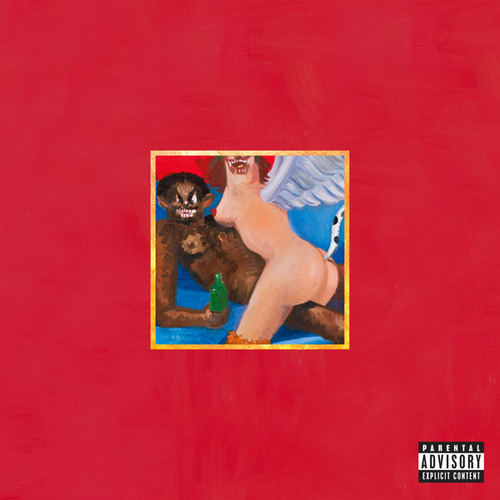
 Kanye West's 2010 album, "My Beautiful Dark Twisted Fantasy." An album that I honestly believe is my generation's "Thriller." Yes. Really. I said it.
Track Listing:
1. Dark Fantasy
2. Gorgeous
3. Power
4. All of the Lights (interlude)
5. All of the Lights
6. Monster
7. So Appalled
8. Devil In a New Dress
9. Runaway
10. Hell of a Life
11. Blame Game
12. Lost in the World
13. Who Will Survive in America? (poem/excerpt by Gil-Scott Heron)
14. See Me Now (bonus track)
Up until around this past July, I was what you would call a hip-hop purist or elitist. I believed that all Hip-Hop and Rap released between 1980 and 2000 was great, everything released between 2000 and 2005 was decent, and everything in following years was a decline for the genre. I thought that Rap was in a state of emergency and needed a return to form sooner rather than later, or else it would be forever desecrated by corporate greed and "ringtone rappers." While I believe this is true to an extent (corporatism has a much larger hold on hip-hop than it used to, and ringtone rappers like Lil' Wayne are even more popular now than they were in 2006), I was wrong about hip-hop needing to return to it's golden age, and wrong about the genre as a whole taking a turn for the worse. The genre is evolving, and the album that has started this new era is Kanye West's 2010 masterpiece entitled, "My Beautiful Dark Twisted Fantasy."
What makes this album so groundbreaking isn't West's lyrical delivery (I've always preferred a more poetic approach to rap lyrics) or his content (West's older albums dealt more with social issues like education, and racism while his newer material is more introspective and often comes off as arrogant), but rather the way all of the songs are produced and mixed. West blends the sounds of all his previous albums with this most recent production, mixing the soulful sounds of "The College Dropout" (2004), and "Late Registration" (2005) along with the electronic sounds of "Graduation" (2007), and finally, the depressingly melodic tones of "808s and Heartbreak" (2008). Not only does he incorporate qualities from his previous albums, but West also does something with samples that I have never heard before in hip-hop; rather than just taking an excerpt from a song, applying a beat, and looping it while he raps over the audio, West just takes very subtle samples (like Pete Rock, C.L. Smooth, Marvin Gaye, Smokey Robinson, and Gil-Scott Heron) and forms his own full composition of music to match it. The samples in this case, are used as accompaniment for an original piece of music rather than being a part of the beat itself as was done in the earlier days of hip-hop. The most notable song on the album is "Runaway," a whopping 9 minute long emotional epic fueled by an orchestra of violins, a piano, a CL Smooth/Pete Rock drum/vocal sample, and Kanye West's actual (though at times, cringe worthy) singing voice. West explained that with this album he was going for a more rap/rock sound and he succeeded. When I say rap/rock, I don't mean like Rage Against the Machine (a band that used heavy metal instrumentation with rap vocals) but more like the Gorillaz, who blended rock sounds with rap sounds so seamlessly that their music essentially became it's own genre. Because of this brilliantly produced new sound, "My Beautiful Dark Twisted Fantasy" has actually changed rap forever.
This brings me to my final point: the new era. As much as i love the classic rap sounds i must inform all hip-hop elitists that the genre is far from dead. While the radio does have an over saturation of mainstream rappers who all sound the same, what I've realized is that not only does rap have innovative and ambitious saviors like Kanye West, but even these mainstream rappers we love to hate are helping the genre rather than hurting it, and here's why: when rock music began in the '50s it was just one genre, and it stayed that way until the '70s when it began to split into sub genres like metal and punk. The '80s saw the rise of glam metal, the '90s was alternative, and rap-rock, and finally, the '00s saw the blend of blues and garage rock. As rap is a much younger form of music than rock, it makes sense that it would just now begin to make the same transformation. Before, hip-hop was just one genre, but now, like rock, it is beginning to split into sub genres. We now have pop-rap (those rappers we love to hate such as Lil' Wayne and Soulja Boi), more traditional rap (Common, Mos Def, Talib Kweli, Nas, Eminem and Jay-Z), and what could be considered experimental (Kanye West, and Gorillaz).
We need to be happy. Hip-Hop is growing up and developing as opposed to be being placed in a little box for all of it's existence. If "My Beautiful Dark Twisted Fantasy" is any indicator this is not a dark or depressing time for rap, but rather, the start of something very exciting.


 Posts
Posts


